How Algorithms Are Tearing Chinese Men and Women Apart
Algorithms did not invent China’s gender tensions, but they keep selecting the most provocative true stories—teaching men and women to fear each other before they even meet.
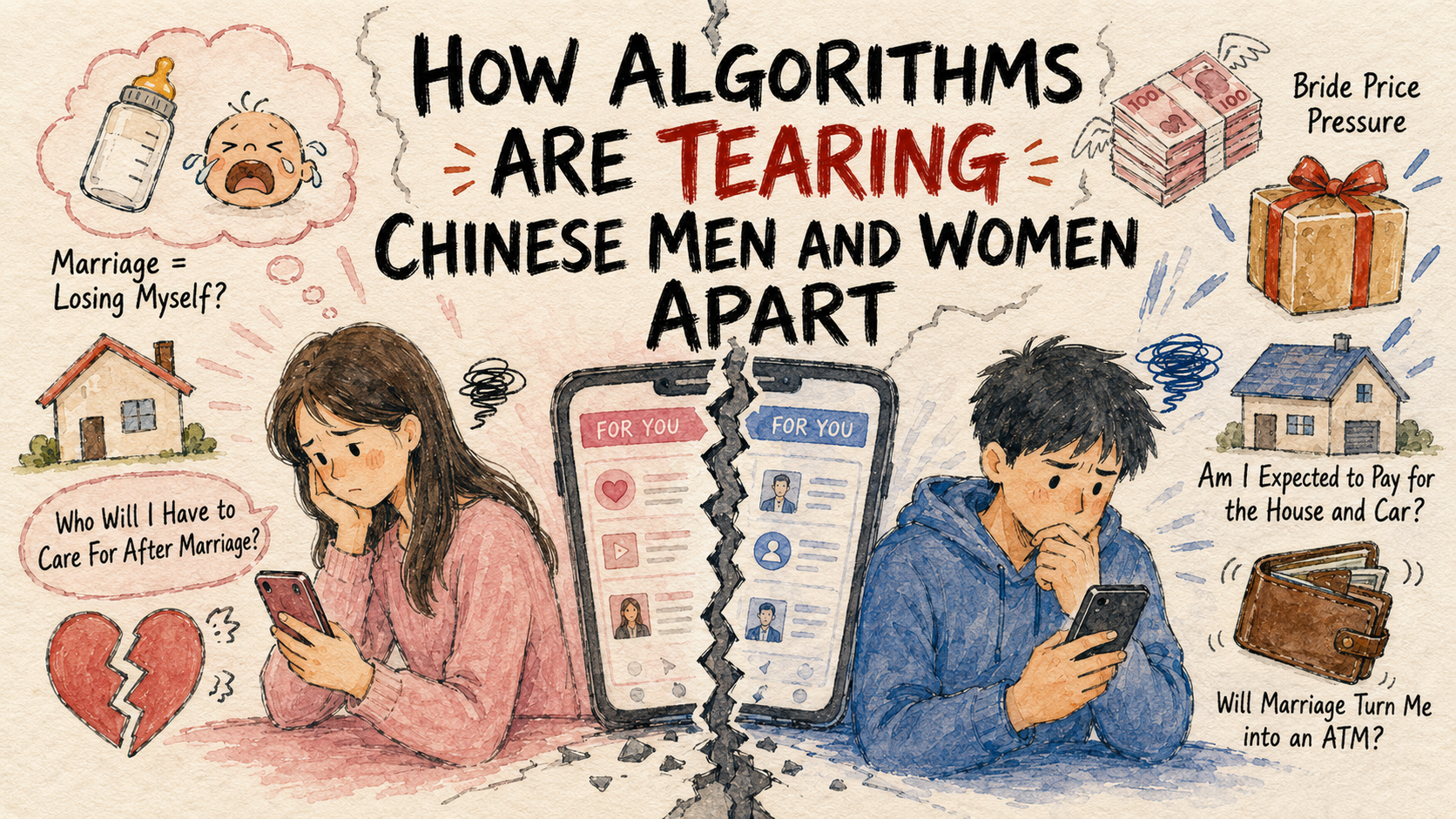
It was after eleven at night when Lin Xi stopped on a video.
On screen, a woman spoke confidently to camera. The title read:
“You do not know what solo parenting inside a marriage means until you have a child.”
Lin Xi did not like it or leave a comment. She only paused for a dozen seconds, then opened the creator’s profile and watched two more clips.
What followed looked increasingly familiar: conflict with in-laws, husbands changing after marriage, full-time mothers being abandoned.
Lin Xi was twenty-eight, unmarried, and had never been betrayed by a man. Her boyfriend treated her well. They had already discussed registering their marriage the following year.
But that night, for the first time, she seriously wondered:
What if the way he treats me now is all an act?
At the same time, on the other side of the city, Zhou Yuan was also scrolling through videos.
The first was about a bride price of RMB380,000.
The second showed a man explaining that after marriage he surrendered his entire salary and had to report even the purchase of a pack of cigarettes. The comments and floating captions mocked him relentlessly.
The third title was more direct:
“The greatest risk an ordinary man faces is marrying the wrong woman.”
Zhou Yuan was twenty-nine. No woman had cheated him out of money, and he had never encountered the kind of “gold digger” described online. In real life, most women he knew had jobs and lived ordinary lives.
But if you saw only his recommendation feed, you would think marriage had become a coordinated hunt targeting average men.
Lin Xi feared being sacrificed.
Zhou Yuan feared being drained.
They had never met, yet they had already begun guarding themselves against each other.
Neither had been hurt by the other. Other people’s stories had simply armed them in advance.
This is the first step in how algorithms divide men and women.
One
Many people think a recommendation algorithm merely “guesses what you like.”
In reality, it is constantly testing you.
Which video made you stop? Did you finish it? Did you open the comments? Did you watch it again? Every action becomes input for the next round of recommendations.
You may say, “This video is nonsense.” The algorithm sees that you stayed.
You may write a five-hundred-word rebuttal. The algorithm sees deep engagement.
The angrier you become, the harder it is to look away—and the more likely the system is to serve you another dose, like the itch buried beneath a wound that has only just closed.
A 2025 algorithm audit published in PNAS Nexus found that recommendation systems optimized for engagement were more likely to amplify emotionally charged content attacking an outside group than systems ordered by preferences users explicitly reported afterward. What people engage with most is not necessarily what they truly want to see once they have calmed down.
That study examined political content on overseas platforms. It cannot directly establish how Chinese platforms handle dating and marriage. But it explains a crucial problem:
The platform knows what will provoke you. It does not care what is good for you.
Lin Xi may initially have finished one video about a marital dispute by accident.
The algorithm noticed her reaction and sent several more. The more she watched, the more dangerous marriage seemed. The more dangerous it seemed, the more closely she followed similar stories.
The same happened to Zhou Yuan.
At first, he simply felt that starting a family was expensive. Several months later, his home feed was crowded with bride prices, housing costs, and disputes over property after divorce.
The algorithm first learns who you are from your reactions. It then uses its recommendations to influence who you become.
Eventually, you begin to treat the sample it selected for you as a conclusion you reached by seeing the world clearly.
Two
The algorithm’s greatest power is not its ability to manufacture fake news.
It does not need to invent anything.
Across the lives of more than a billion people, betrayal, domestic violence, marriage fraud, bride-price disputes, and conflict with in-laws happen every day. A platform only needs to select the examples most likely to shock people into stopping.
Every individual story may be true.
Watch ten thousand of them in a row, and the world they form may still be false.
In 2026, a survey on young people’s attitudes toward relationships and marriage, conducted by Beijing Normal University and a social-media platform, covered 2,823 people aged eighteen to thirty-five. Of them, 76.6% said social media had influenced their views on marriage and childbearing.
Researchers summarized the algorithmic effect in three layers: discussion of relationships becomes increasingly narrow; people with the same views reinforce one another; and once a user develops a certain belief, the algorithm continues feeding them matching content until that belief hardens.
For Lin Xi, the sequence looks like this:
She sees several failed marriages, begins to fear marriage, and then—because she is afraid—pays even more attention to failed marriages.
The platform never explicitly tells her that men cannot be trusted.
The algorithm has no opinion. It simply keeps placing the least trustworthy men in front of her.
Zhou Yuan sees a different reality.
He rarely sees ordinary couples sharing a mortgage, or the way most women work and live. Those stories contain little conflict, so more extreme cases quickly push them out of view.
A husband who remains faithful for ten years does not post a daily video proving it.
A wife who helps her husband pay a mortgage is unlikely to trend.
Normal relationships sink from sight.
Extreme cases are pulled up, one after another, and made to represent an entire gender.
The algorithm is not lying.
It is simply cutting most of reality out of the frame.
Three
Gender relations are especially easy for algorithms to amplify.
They involve housing, money, childbirth, family, and dignity—things almost everyone can project themselves into. Rewrite one concrete dispute as a gender war, and the comment section quickly loses control.
“This man hurt his wife” is a problem involving one person.
“Men become irresponsible after marriage” instantly turns it into a problem involving hundreds of millions.
“This woman made an unreasonable demand” describes one dispute.
“Women today are all materialistic” creates a common enemy.
A 2021 study in The Chinese Journal of Communication and Society analyzed 4,440 Zhihu answers and questions about so-called “pastoral feminism,” a derogatory online label for radical or self-serving feminism. It found that online debate often compressed complex questions into a binary opposition between “real” and “fake” feminism. Topics such as bride price, childbirth, and children’s surnames were especially likely to intensify gender judgments.
This is how online gender content is often processed:
Remove the context, leaving only a position.
Hide the individual, highlighting only their gender.
International research has likewise found that attacking an outside group generates more sharing than simply praising one’s own side. Political polarization cannot be equated directly with gender relations, but the distribution logic is similar:
Telling people who is hurting us attracts more traffic than explaining the problem itself.
The platform may not care whether men or women are right.
As long as both sides continue fighting, watch time, comments, and shares keep rising.
Creators have learned how to run this business too.
Tell one extreme story. Generalize it into a rule about an entire gender. Then end with:
“What do you think?”
Angry viewers will produce the rest of the traffic for free.
Four
The most serious consequence is not that men and women hold different opinions.
It is that they no longer see the same reality.
Every day, Lin Xi sees the cost of childbirth, unequal housework, and husbands who betray their wives.
Every day, Zhou Yuan sees housing prices, bride prices, and financial risks after marriage.
All of these pressures are real.
But when an algorithm displays only one side for long enough, pain on the other side starts to sound like an excuse.
When women discuss the risks of childbirth, men think they are selling anxiety.
When men discuss the cost of starting a family, women think they simply refuse to contribute.
Both sides are stating facts. They just no longer share the same set of facts.
That defensiveness eventually enters real relationships.
On a first date, a woman casually asks whether the man owns a home. He immediately recalls the countless “gold diggers” on his feed.
When a man suggests paying the mortgage together after marriage, the woman remembers stories about “stingy men scheming to take their wives’ income.”
The person sitting in front of them has done nothing wrong. The algorithm has already prepared an accusation.
In the past, people judged someone through the experience of spending time together.
Now, before many people have even met, they have already watched hundreds of stories explaining how dangerous “people like that” can be.
They are not getting to know each other.
They are demanding that the other person prove:
You are not one of those people on my phone.
Five
It would be wrong to blame every conflict between men and women on algorithms.
Housing pressure, the cost of childbirth, family responsibilities, and traditional gender roles already exist. Without those cracks, extreme content would not resonate so easily.
The algorithm is more like a bellows.
It did not light the first fire, but it knows exactly where the flames are strongest.
A large experiment published in Nature in 2023 reduced exposure to like-minded sources by roughly one-third for more than twenty thousand US Facebook users. The sources of information participants saw changed, but several measures of political attitude did not shift significantly.
An algorithm cannot rewrite someone’s mind at the press of a button.
But by changing the ranking, a platform can substantially change what that person encounters every day.
The algorithm may not persuade Lin Xi to reject marriage completely.
But it can make betrayal the first image that appears whenever she thinks of marriage.
It may not make Zhou Yuan hate women forever.
But it can make avoiding loss the first thing he thinks about on a date.
A person’s stated position may not change immediately.
Trust can still be worn away first.
Six
The first step out is not winning an argument in the comments.
Hate-watching is still watching.
Replaying a clip, opening the creator’s profile, and reading hundreds of comments all continue sending signals of interest to the system.
When content is plainly engineered to provoke gender hatred, swiping away and choosing “Not interested” is usually more effective than writing a long rebuttal.
China’s current Provisions on the Administration of Algorithm-Generated Recommendations for Internet Information Services also require platforms to offer options not based on personal characteristics, or an accessible way to turn off algorithmic recommendations. Users have the right to select or delete the personal tags used for recommendations.
The second step is learning to look for the denominator again.
When you see a story about someone demanding a bride price of one million yuan, ask where it happened, what the two families earn, what their circumstances are, and whether this is common—or simply an outlier perfectly designed to spread.
A case can alert you to a risk. It cannot calculate the probability of half of humanity.
Gender can explain part of a structural difficulty. It cannot judge a living person for you.
Lin Xi and Zhou Yuan have never been hurt in a relationship.
Yet both are already prepared to become victims.
References and further reading
- People’s Daily and Xinhua: Do Not Let Algorithms “Lock In” Young People’s Views on Marriage and Childbearing (Chinese)
- Milli et al., PNAS Nexus: Engagement, user satisfaction, and the amplification of divisive content on social media
- Gan Lihua, The Chinese Journal of Communication and Society: Patriarchy, Online Misogyny and the Chinese Interpretation of Feminism (Chinese)
- Rathje et al., PNAS: Out-group animosity drives engagement on social media
- Nyhan et al., Nature: Like-minded sources on Facebook are prevalent but not polarizing
- Cyberspace Administration of China et al.: Provisions on the Administration of Algorithm-Generated Recommendations for Internet Information Services (Chinese)
- Eli Pariser, TED: Beware online “filter bubbles”
Author’s note
Lin Xi and Zhou Yuan are fictional characters built from common online narratives about dating and marriage. They do not correspond to any specific person, and their stories are not presented as real interviews.
This essay does not argue that algorithms are the sole source of conflict between men and women. It asks how personalized recommendations select more emotionally provocative content from real social tensions and, through continuous feedback, intensify the differences between what groups are exposed to.
Some international research cited here examines political communication and overseas social platforms. It cannot serve as direct causal evidence about gender relations in China. It is included to explain possible mechanisms involving engagement-based ranking, hostility toward outside groups, and exposure to homogeneous information.